

From Forest to Plate: How Truffles Are Actually Found in Italy
From Forest to Plate: How Truffles Are Actually Found in Italy
It is four o’clock on a damp October morning in the hills above Alba. A man in a long oilskin coat steps out of a battered Fiat Panda, closes the door softly, and reaches into the passenger seat for a curly-coated dog with a mud-stained collar and the patient expression of a professional. This is Marco, a trifolau, the Italian word for a truffle hunter. This is Bruno, his Lagotto Romagnolo. They have done this a thousand times. They are about to do it again, in the dark, in silence, and they will be back in the village by mid-morning with, on a good day, a single truffle the size of a walnut.
This is how the most expensive culinary ingredient on earth actually arrives in your kitchen. Not from a warehouse. Not from a farm. From a forest, in the dark, one truffle at a time. Here is the whole journey in the order it actually happens.
What a truffle actually is
Before the hunt, a definition. A truffle is not a mushroom. It is the fruiting body of a subterranean fungus that grows in symbiosis with the roots of specific trees, chiefly oak, hazel, beech, lime and poplar. The fungus and the tree exchange nutrients through microscopic connections at the root tips, and the truffle grows six to twelve inches underground, invisible from the surface, throughout the summer. By autumn it is ripe, aromatic, and, crucially for the hunter, fragrant enough for a dog to smell from several metres away.
This underground, symbiotic, fragrant nature is the reason truffles are so hard to farm. You cannot plant a truffle. You can, at best, encourage one, by planting inoculated saplings in the right soil and hoping.
Where they grow
Italy has the two most prized culinary truffles in the world, and both grow in the country’s central and northern belt. The famous white truffle (Tuber magnatum) is essentially exclusive to Piedmont, particularly the countryside around Alba, though smaller quantities are found in Molise and Marche. The Italian black winter truffle (Tuber melanosporum, also cultivated in France’s Périgord) grows through Umbria, Tuscany, Abruzzo and Lazio. Summer black truffle (Tuber aestivum) is the most widespread of all, appearing across most of central and southern Italy from May to August.
Each of these truffles has its own preferred tree, its own soil chemistry, its own season, and its own price bracket. The one thing they share is a stubborn refusal to be grown on demand.
The hunters
Truffle hunting in Italy is a job that runs in families. A trifolau is not a hobbyist. He (and it is mostly, though not exclusively, still men) inherits knowledge of the forest from his father and grandfather: which trees produce every year, which produce only in wet years, which have been picked clean by strangers, which are worth returning to at 3am to avoid being followed. Trifolaus are famously, sometimes comically, secretive. They will invent detours to throw off anyone tailing them, memorise their best trees rather than write them down, and refuse to bring even close friends into the good spots.
They also work at night or before dawn, partly because dogs work better in cool, damp conditions, and partly because there is less competition from other hunters. A single productive tree can be worth several thousand euros a season, and this is knowledge that people quietly hurt each other for. Poisoned dogs, sadly, are a real and grim hazard of the trade.
The dogs
For centuries, truffle hunting was done with pigs, whose natural instinct for rooting in soil made them ideal. The problem was that pigs also want to eat truffles, and a good sow could destroy the harvest before her handler could reach her. By the mid-twentieth century, dogs had largely replaced them, and one breed above all: the Lagotto Romagnolo, a curly-coated water dog originally bred in the Romagna marshes.
Lagottos are ideal for the job because they are small enough to work in dense undergrowth, obedient enough not to eat the find, and blessed with a nose that can pick up mature truffle from surprising distances. Trained from puppyhood on truffle-scented cloths and buried rewards, a good working Lagotto is worth thousands of euros and is often the most treasured member of a truffle-hunting family.
The dig
Once the dog signals (usually by pawing at the soil in a particular spot), the hunter kneels down with a small hooked knife called a vanghetto and gently excavates by hand. The goal is to remove the truffle without breaking the delicate mycelium threads that connect it to the tree, because those threads are the reason the same spot will produce again next year. The hole is refilled carefully. The dog gets a small reward. The truffle goes into a padded satchel. The two of them move on to the next tree.
On a good morning, a hunter might find three or four truffles totalling a few hundred grams. On a bad morning, nothing at all.
The journey to your plate
Speed is everything from here. A fresh truffle has perhaps a week of useful aromatic life before its volatile compounds begin to drift away, so the supply chain is engineered for urgency. Truffles are cleaned gently with a brush (never washed, which damages the skin), weighed, graded, and sold within hours to specialist buyers who then courier them to restaurants and merchants across the world. They travel in small tins packed with rice or eggs, both of which absorb and hold the perfume, so that even the shipping medium becomes a delicious side product.
By the time the truffle reaches the pass at a restaurant in London, Tokyo or Dubai, it has been out of the ground for three or four days. It has another three or four in it, if you are lucky.
Why any of this matters
Understanding how truffles are found changes how you eat them. You are not just paying for a fungus. You are paying for a wild product no one has domesticated, a hunter and a dog on pre-dawn shifts in cold woodland, a supply chain running on days rather than weeks, and generations of quiet, guarded knowledge. That is what sits on top of your pasta.
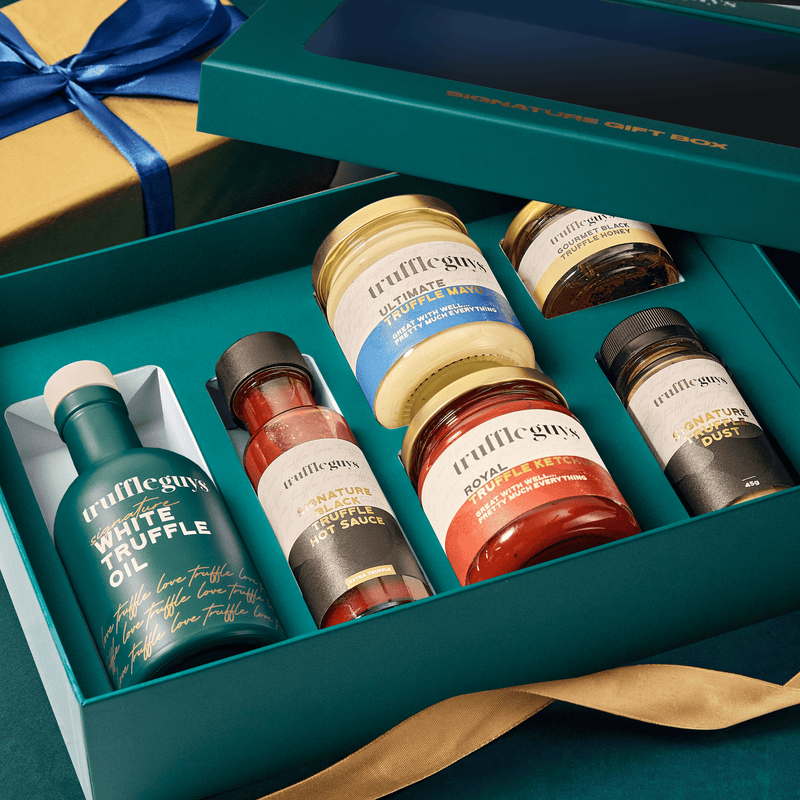
It also explains why the best truffle products bother to source their raw ingredient properly. Our Italian Minced Truffle, our White Truffle Oil and our Signature Truffle Dust are all built on real truffle from Italian producers who work inside this system. What arrives in the jar is a fraction of the price of the fresh truffle, but the story behind it is exactly the same. Someone got up at four in the morning, in the rain, with a dog. And the whole thing began under an oak tree in the dark.