

White vs Black Truffle: Which One Should You Actually Buy?
Stand in front of a shelf of truffle products for the first time and you meet the same fork in the road, every single time. White or black? The labels rarely explain themselves, the prices swing wildly, and the internet is full of people insisting that one is the real truffle and the other is for amateurs. Ignore them. Both are real, both are wonderful, and they are built for completely different jobs.
The good news is that choosing between them is genuinely simple once you know what each one is for. Here is the whole decision, minus the snobbery.
First, what they actually are
Both white and black truffles are the fruiting bodies of underground fungi that grow in partnership with the roots of certain trees. White truffle is Tuber magnatum, the famous Alba truffle from northern Italy. Black truffle is usually Tuber melanosporum, the Périgord truffle, or its milder cousin Tuber aestivum, the summer truffle. They look different, they smell different, and, crucially, they behave very differently the moment they reach a kitchen.
How they taste
White truffle is the loud one. Sharp, pungent, intensely garlicky, with a high, almost cheesy note that seems to fill a room the second it appears. It is the truffle that makes people gasp. Black truffle is the grounded one: deeper and earthier, with notes of cocoa, mushroom, hazelnut and damp forest floor. It is rounder, warmer, and far easier to fall for on a first encounter.
If white truffle is a soprano hitting a high note, black truffle is a cello in a quiet room. Most people find black the more comfortable everyday companion and save white for the occasional showstopper.
How you actually use them
This is where the real difference lives, and where most buying decisions should be made.
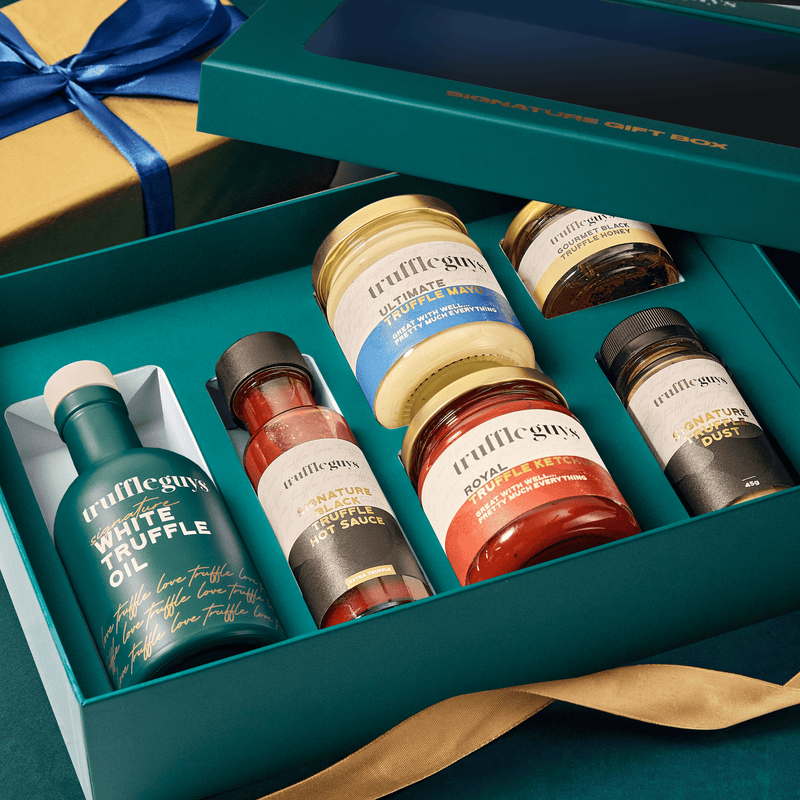
White truffle is almost never cooked. Its aroma is so volatile that heat scatters it in seconds, so it is shaved raw at the very end, over warm pasta, risotto or eggs, where it blooms into the air. In product form, that delicate, heady quality is best captured in a finishing oil. A few drops of White Truffle Oil over a finished dish give you that white-truffle drama without the eye-watering price of the fresh tuber.
Black truffle is more robust. It still dislikes a screaming hot pan, but it holds up beautifully folded into fats and gentle warmth, which is why it is the truffle of choice for condiments and sauces. It is the truffle inside Ultimate Truffle Mayo, Gourmet Truffle Mustard, Black Truffle Hot Sauce and Ultimate Truffle Pasta Sauce, where its earthiness has something to cling to.
Why white usually costs more
White truffle is rarer, more seasonal and impossible to farm reliably, so it commands the higher price. That is why white-truffle products tend to be oils and infusions, where a little goes a very long way, while black truffle, more available and more heat-tolerant, turns up across a whole range of everyday jars and bottles. Neither is better. They simply sit at different points on the scale of drama and price. (Our earlier piece on why truffles are so expensive goes much deeper on the economics, if you want the full story.)
So, which should you buy?
Here is the short version.
Buy white, in the form of oil, if you want a finishing flourish: the drizzle over pasta, eggs or risotto that makes a plate smell like a Piedmont autumn. Reach for White Truffle Oil and use it raw, off the heat, at the table.
Buy black if you want truffle woven into everyday food: the mayo in your burger, the mustard on your board, the sauce on your weeknight pasta. Black truffle products do the quiet, daily work, and they do most of it for under a tenner a jar.
And if you cannot choose, you are in very good company, because most truffle lovers end up wanting both. The Truffle Starter Pack is the tidy way to get there, pairing white truffle oil with black truffle mayo and our versatile Signature Truffle Dust, a porcini-and-black-truffle blend that goes on almost anything. It is the simplest way to taste the full range and work out which side of the divide you fall on.
The truth nobody selling you a single jar will admit is that white versus black was never really a competition. One is for the moment you want to show off. The other is for every other day of the week. A good truffle shelf, in the end, has room for both.